
Plan the patio woodwork before the concrete is poured
How to list the wooden pieces around a new concrete patio, estimate the timber and settle fixings and drainage before the pour.
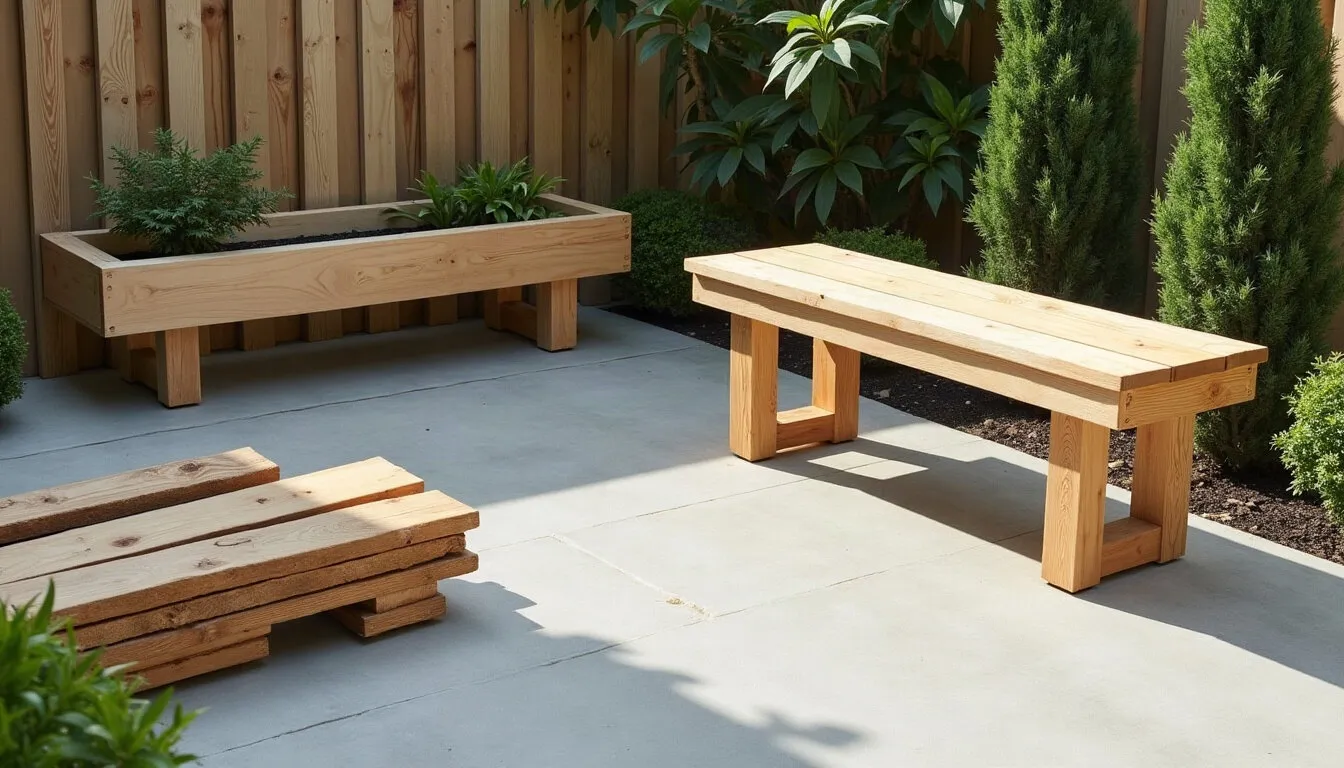
A new concrete patio sets hard in a few days, and from then on everything wooden around it has to work with what was poured. A bench that needs fixing points, a planter that should drain away from the slab or a privacy screen that needs posts all depend on decisions that are cheapest to make while the concrete is still a plan.
What should you ask a local installer such as Franklin TN Concrete Works before the forms go down, if wooden pieces will sit on or beside the new patio? This guide sets out the wood side of that conversation: listing the pieces, estimating the material, and finding the points where the woodwork and the concrete meet. It is for benches, planters, edging and light screens. Anything overhead, such as a pergola or roof, is a structural question for a qualified builder and the local building department.
List the wooden pieces before anyone quotes the slab
Start with a plain list of every wooden item you expect to have on or around the patio in the next few years, not only the ones you will build this season. A typical list might include a fixed bench, two or three planter boxes, a low screen along one side, and timber edging where the patio meets the lawn.
For each item, write three things: where it will stand, whether it will be fixed or freestanding, and whether it touches the concrete, the soil or both. This list does not need dimensions yet. Its job is to show the concrete installer where the slab must accommodate wood, so that nothing is decided by default.
Find every point where wood meets concrete
Wood and concrete get along well when water can leave the joint between them, and badly when it cannot. Concrete holds moisture against anything resting on it, and the end grain of a board, the cut face across the fibers, draws water up much faster than its sides.
Go through your list and mark each contact point. A freestanding planter on feet is a small contact. A bench fixed to the slab is a fixing question. A post set into or onto the concrete is a larger question, because it is both a fixing and a moisture trap. The contact points, not the size of the pieces, decide what the concrete installer needs to know.
Decide fixings while the concrete is still a plan
Some fixings are set into wet concrete and some are added after it cures. Which approach suits a given piece is a question for the concrete installer and, for anything that carries a load or stands tall, for a builder or engineer. What you can do is make sure the question is asked before the pour.
Write it in full: "We plan a fixed bench here and a low screen along this edge. Should anything be set in the concrete for them, or will they be fixed afterward?" Ask also whether the patio will slope for drainage and in which direction. A bench or planter placed at the low edge of a slope will sit in runoff after every rain, and Middle Tennessee gets enough wet weather for that to matter.
Estimate the timber in bands, not single figures
Once the pieces and their positions are settled, estimate the wood. Separate the finished size of each part, the size it ends up after cutting and planing, from the size you buy. Lumber is sold in nominal sizes, the names used at the yard, and the actual dimensions are smaller. A board sold as a "two by six" does not measure two inches by six inches.
Work out a cut list for each piece: every part, its finished length and how many. Then group the parts by the board size they come from and see how many full boards each group needs. Rather than adding a fixed percentage for waste, look at where the offcuts fall. Sometimes one extra board covers every defect and mistake. Sometimes a long part forces you to buy a board where most of the length will be spare. Give yourself a low and a high count for each board size, and order toward the high end only where a shortage would stop work.
A hypothetical cut list
This is an invented example to show the reasoning, not a design to copy.
Suppose the list includes one fixed bench and two matching planter boxes beside it. The bench has a seat of several boards, two leg frames and two rails. Each planter has four sides of stacked boards, four corner posts and a slatted base.
Written as finished parts, the bench needs its seat boards at the bench length, four legs, and short rails and cleats. The planters need side boards at two lengths, eight corner posts and base slats. Grouping by board size shows that the seat boards and the long planter sides can come from the same stock length with little spare, while the legs and corner posts can be cut from offcuts of a thicker board. Writing this out turns a vague "about a dozen boards" into a list that a timber yard or a builder can check.
| Piece | Contact with concrete | Question for the installer |
|---|---|---|
| Fixed bench | Feet fixed to slab | "Should anything be set in the concrete for this?" |
| Planter boxes | Feet or base on slab | "Which way does the slab drain at this edge?" |
| Low screen | Posts at or beside the slab | "Will posts sit in the slab, beside it or on separate footings?" |
| Timber edging | Along the slab edge, in soil | "How will the slab edge be finished where it meets the lawn?" |
Keep end grain off wet concrete
Many outdoor wooden failures start at the bottom. A post or leg that sits directly on concrete, with its end grain in contact, can stay damp long after the surface has dried. The same happens where a planter's bottom boards rest flat on the slab.
Small spaces solve most of this. Feet, spacers or raised bases lift wood clear so air can move and water can run off. A good contractor or builder will have a view on how to do this for fixed pieces. For freestanding ones, the decision is yours, and it is easy to include in the cut list now rather than improvise later.
Treated lumber is often chosen for parts in contact with the ground or near it. Ask the timber yard which treatment and use category the product is labeled for, and follow the handling directions that come with it. Untreated softwood is fine for many above-ground parts, provided it can dry out between wettings.
Cut ends deserve their own line on the plan. Every time a board is cut to length, fresh end grain is exposed, and that face takes up water far faster than the rest of the board. Whatever finish or treatment you choose for the outdoor pieces, note that cut ends get it too, following the product's directions. It is a small step that is easy to forget once the bench is assembled and the bottoms of the legs are out of sight.
Sequence the work so the concrete cures first
Concrete needs time to cure before it should carry furniture or be drilled. Ask the installer how long to wait before fixing anything to the new slab and before placing heavy planters. Write the answer on your plan so that no one, including you, gets ahead of it.
A sensible order is:
- Settle the list of wooden pieces and their positions.
- Agree on drainage direction and any fixings with the concrete installer.
- Let the slab cure for as long as the installer advises.
- Buy and store the timber off the ground, covered but ventilated.
- Build or install the wooden pieces, starting with anything fixed.
Storing timber during the cure matters more than it seems. Boards left on a damp lawn or against a fresh slab can pick up moisture and twist before they are used.
The pencil list
- List every wooden item planned for the patio, with its position and how it meets the concrete.
- Ask the concrete installer which way the slab will drain and where the low edge falls.
- Write down any fixings that must be decided before the pour, and who decides them.
- Note the installer's advice on how long to wait before fixing or loading the slab.
- Keep a cut list with low and high board counts for each size.
The slab and the woodwork are one project, even when different people build them, so put both on the same page before the concrete is poured.
Keep the notebook open.

How to mock up a kitchen layout before the cabinets are ordered
How to build a full-size cardboard and scrap-wood mock-up of a new kitchen, test doors and walkways, and bring clear notes to your contractor.
1 Nov 2026 · Mateo Briggs
Wrap finished woodwork before the ride down from the mountains
How to list, sort and wrap handmade wooden pieces after a group trip to the mountains, so fresh finishes and fragile edges survive the ride home.
21 Oct 2026 · Felix Rowan
How to inventory exterior wood before asking for painting quotes
How to list, group and describe the condition of every piece of exterior wood on a house, so painting quotes can be compared item by item.
14 Oct 2026 · Felix Rowan