
Board feet, real sizes and what you actually buy
Keep nominal, actual and finished dimensions separate, then check the volume and the supplier’s billing basis.
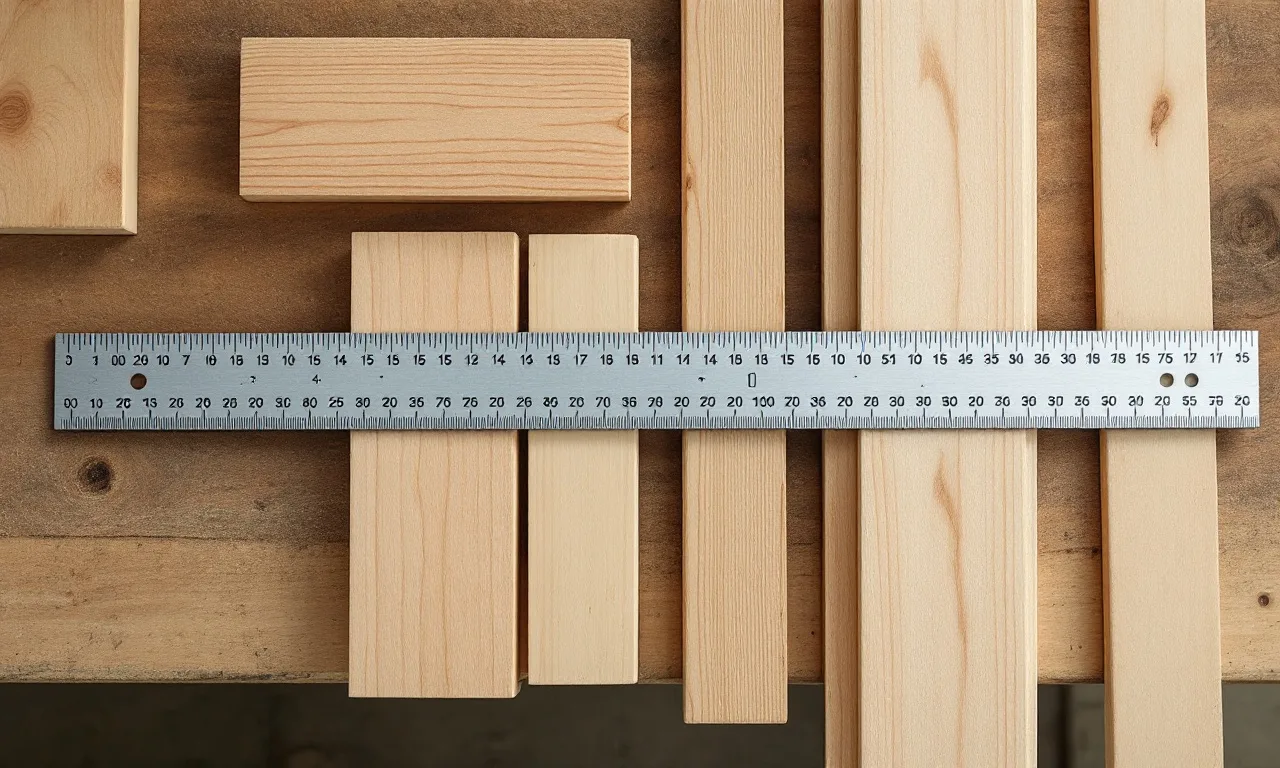
A timber quotation is easy to misread when three kinds of size appear on the same page. There is the name used at the rack, the physical size of the board in your hands and the size of the part you intend to make. A fourth number, the billed quantity, may use its own agreed measuring basis. Keep those numbers separate and a confusing order becomes much easier to check.
Board feet measure volume. They do not describe a board's quality, straightness or usable length. A cubic metre is also a volume. Neither unit tells you whether a wide panel can be made from the narrow boards on offer. This guide explains the arithmetic and, just as importantly, where the arithmetic stops.
What one board foot represents
One board foot is the volume of a piece 12 inches long, 12 inches wide and 1 inch thick. Multiplying those dimensions gives 144 cubic inches. That is a unit definition, not a standard board that every supplier must sell.
When thickness and width are in inches and length is in feet, the convenient formula is thickness multiplied by width multiplied by length, divided by twelve. The denominator accounts for the conversion between feet and inches in the length measurement. Multiply by the number of identical boards only after confirming they really have the same dimensions.
For example, a hypothetical board measuring 1 inch by 6 inches by 8 feet contains 4 board feet on that basis. Four identical boards contain 16 board feet. If the physical dimensions are smaller, calculating with the physical dimensions gives a smaller physical volume. That does not automatically mean a supplier's bill is wrong; first establish the agreed trade basis.
Nominal and actual are different labels
Nominal dimensions can function as a product name or trade designation. Actual dimensions describe the physical board after the relevant drying or surfacing. The relationship depends on the product, standard and market. Do not assume every board sold under a familiar name has the exact actual dimensions remembered from another purchase.
Write the nominal description in one column and the measured or specified actual size in another. Then add a column for the dimensions used to price the order. Ask the supplier to explain that last column if it is unclear. A conversation before purchase is easier than discovering a disagreement after the boards have been cut.
For a finished part, actual available thickness matters. A nominal description cannot replace material removed by flattening, planing or sanding. If the project requires a particular finished thickness, tell the supplier that requirement instead of relying on the rack name alone.
Do the calculation in one unit system
For board feet, use inches for thickness and width and feet for length. If your tape reads a length in inches, divide that length by twelve before using the formula above. Alternatively, multiply three dimensions in inches and divide by 144. Both methods should agree when used consistently.
For cubic metres, convert every dimension to metres before multiplying. With thickness and width in millimetres and length in metres, multiply the three numbers and divide by one million. A 25 mm by 150 mm by 2 m board is 0.0075 cubic metres. Four boards are 0.03 cubic metres.
A calculation can look plausible even when one dimension uses the wrong unit. Record the units next to the input numbers. The timber tools show the expected units beside every field and show the formula beside the result. Changing a tab does not convert a number already entered; it changes the units expected by the fields.
Separate finished parts from purchased stock
Imagine a shelf that must finish at 900 mm long. Ordering a board exactly 900 mm long leaves no room to trim a damaged end or make a clean square cut. The purchased rough length and the finished length serve different purposes.
Make a finished-parts list first. Then create a rough-parts list that allows for your preparation method. Finally, lay those rough parts onto the stock lengths available from the supplier. Do not jump directly from the finished-parts volume to a purchase quantity and assume the layout will work.
A group of short parts can often share a longer board efficiently. A single long part may force the purchase of an additional length even when the total volume appears sufficient. The cut-list article provides a way to keep those constraints visible without treating the calculator as a cutting optimizer.
What a waste allowance can do
An allowance is an explicit planning margin. If the base volume is 16 board feet and you add 15 percent, the planning quantity becomes 18.4 board feet. The extra 2.4 board feet is not a prediction of exactly how much waste will occur. It is a decision about how much margin to budget.
Different projects justify different allowances. Short hidden parts, long clear rails, wide appearance panels and heavily machined stock do not produce the same yield. A fixed percentage should not conceal known defects or an impossible cut layout. If you already know a split end will be discarded, account for it in the layout rather than hoping the general allowance covers everything.
Write why the allowance was chosen. Even a short note such as end trimming plus one spare short rail is better than a number copied from a previous project. After the work, compare the actual offcuts with that note so the next estimate is informed by a real record.
Compare quotations fairly
Put competing quotations on the same specification before comparing totals. Match the species or group, grade, moisture condition, dimensions, lengths, surfacing and quantity basis. A lower price per board foot can still produce a higher project cost if more preparation or unusable material is involved.
Delivery, handling and machining charges should appear separately where possible. A supplier who delivers boards already close to the required size may save a process you otherwise have to arrange. On the other hand, a small saving in preparation is not useful if the supplied dimensions leave no margin for your final fitting.
Avoid comparing a retail dressed-board price against a rough-lumber price as though both arrive ready for the same operation. The timber order checklist is designed to capture those differences before the order is agreed.
Check a bill without guessing intent
Recalculate a small sample of the order by hand. Select one line with identical boards and another with mixed lengths if the quotation includes them. Confirm that the unit price multiplies by the stated quantity, then check any separately listed fees.
If the result differs, ask which dimensions and rounding rule were used. A discrepancy can come from rounding each board separately, using a nominal basis, including a minimum length increment or simply entering a number incorrectly. The calculation alone does not identify the cause.
Keep a copy of the agreed basis with the invoice. If a later delivery has a different size or count, that document becomes the reference. A calculator screenshot without the supplier's measurement convention is less useful than a clear order description.
An example of volume failing to solve layout
Suppose a project needs two long rails and several short blocks. Two available boards have the same total volume as the required parts, but each is shorter than a rail. The volume matches and the project still cannot be cut. Joining short pieces into a longer structural or loaded part is a design change, not an arithmetic adjustment.
The opposite situation also occurs. One long board can yield the rails and leave offcuts suitable for the blocks, making the layout better than buying each part as a separate piece. To see that opportunity, draw the parts along the available length and include each saw kerf.
Do not turn this example into a universal rule to buy the longest board. Long stock can be harder to transport, store and prepare. Choose the length that fits the parts and the practical constraints of the workshop.
A short worksheet to keep
Record the product description, actual size, billing size, count and unit price. Under that, record the finished parts and the rough allowances. Keep a separate total for purchased volume and planned usable parts. Label the difference as allowance and offcuts rather than calling it a measured waste rate before work begins.
This small distinction makes the numbers honest. The calculation tells you what a stated set of dimensions contains. Your inspection and layout tell you how much of that material is useful. Your order confirms what the supplier has actually promised to deliver.
Source and calculation basis
The unit calculations above are dimensional arithmetic. For the wider distinction between commercial lumber descriptions, drying and surfacing, consult chapters 6 and 13 of the USDA Wood Handbook. These examples are hypothetical and do not establish a supplier's billing convention or a structural design value.
Keep the notebook open.

Write a cut list that survives the timber yard
Translate the drawing into named parts, rough allowances and an actual stock layout before cutting.
8 Jun 2026 · Felix Rowan